
Snapshot
Middle-market activity entered the summer on uneven footing. Capital remains abundant, but Q1 deal activity softened and the market continues to reward quality, scale and preparation over simple availability.
- Q1 2026 U.S. M&A activity below $500 million declined to approximately $51 billion across roughly 700 transactions, down from $61 billion and about 800 transactions in Q4 2025.
- Private equity exit value surged in Q1, but the number of exits declined—clear evidence that a small number of larger transactions are driving the headline recovery.
- Financing capacity improved for strong credits: senior debt increased to approximately 3.3x EBITDA and total debt reached roughly 4.0x, while equity contributions declined modestly.
- Valuation remains highly dispersed by size and buyer type. Financial buyers averaged approximately 7.3x EBITDA in Q1, while strategic buyers averaged 6.8x.
- The practical message is unchanged: capital is available, buyers are selective and credible preparation remains the difference between interest and execution.
“Capital is ready. Buyers are selective. Preparation makes the difference.”
M&A Market Activity
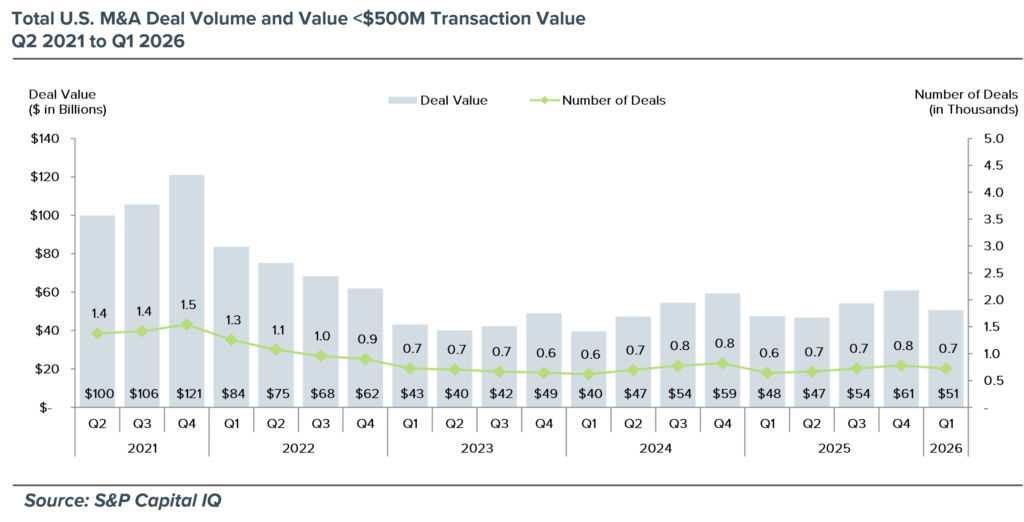
While transaction activity in Q1 2026 was broadly consistent with Q1 2025, it declined from Q4 2025 levels, with aggregate deal value falling to approximately $51 billion from $61 billion and transaction volume decreasing to roughly 700 deals from 800.
- The quarter reinforces the market’s two-speed character: aggregate value can improve in selected areas even while the number of completed middle-market transactions remains subdued.
- Capital availability is not the principal constraint. Seller readiness, valuation expectations, diligence complexity and confidence are determining when, and whether, transactions move forward.
- The recovery is therefore better described as selective than broad-based. Larger, highly defensible assets continue to attract attention, while average companies face longer timelines and more scrutiny.
- For owners, the market is open, but process preparation, positioning and proof of earnings durability remain critical.
Private Equity Capital and Exit Pressure
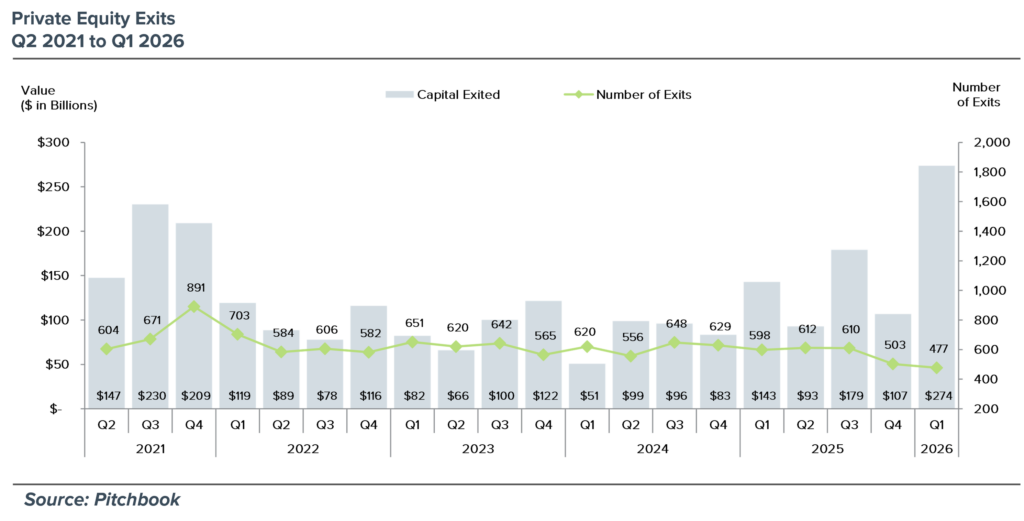
Private equity firms continue to hold substantial undeployed capital, with dry powder totaling approximately $1.07 trillion at year-end 2025.
- Q1 2026 exit value increased dramatically to approximately $274 billion from $107 billion in Q4 2025, even as exit count declined to 477 from 503.
- That divergence is important: liquidity is returning through larger transactions, not through a broad-based increase in the number of portfolio-company exits.
- Aging funds and limited-partner distribution pressure should continue to support both exit activity and competition for compelling new platforms.
- The capital is there. The harder questions are whether an asset can earn conviction, withstand diligence and clear the market’s valuation threshold.
“$1.07 T | The money is there. Conviction—and execution—are harder to find.“
Valuation Environment
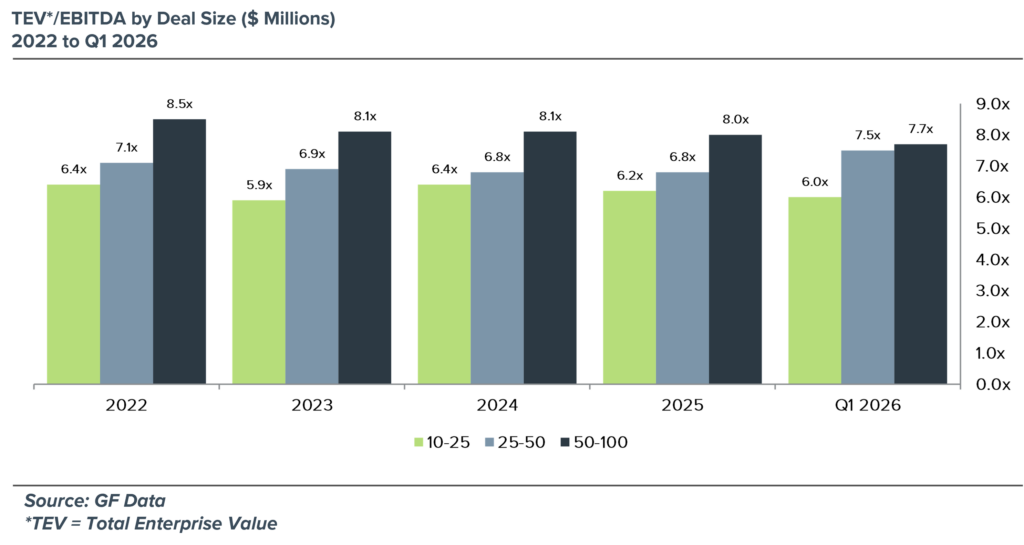
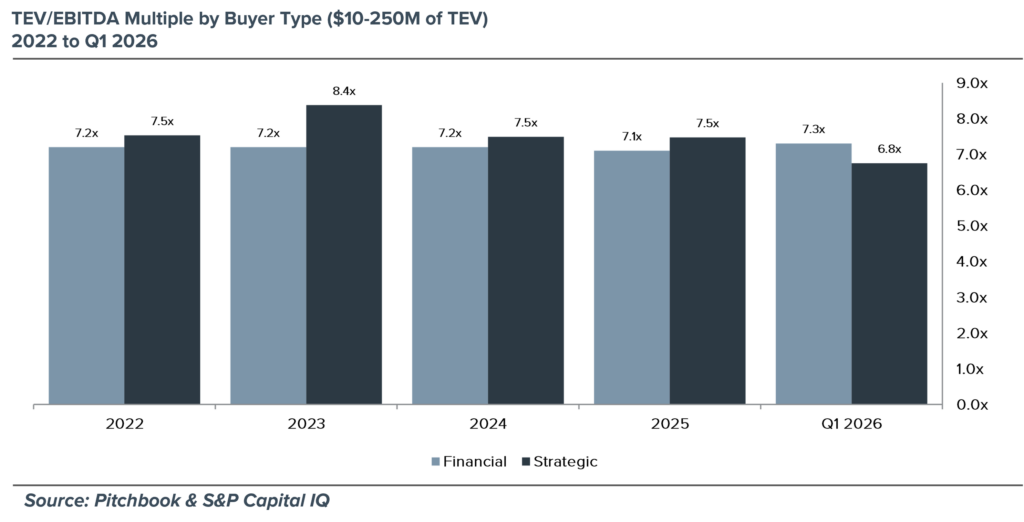
Q1 2026 valuation data shows meaningful improvement in the lower and core middle market, but not a uniform rise across all transaction sizes.
- Average multiples reached approximately 6.0x EBITDA for $10 million to $25 million transactions, 7.5x for $25 million to $50 million transactions and 7.7x for $50 million to $100 million transactions.
- The $25 million to $50 million tier posted the clearest year-over-year improvement, while the $50 million to $100 million cohort remained below its 2022–2024 levels.
- Buyer type also mattered: financial buyers averaged approximately 7.3x EBITDA in Q1 2026, compared with 6.8x for strategic buyers, a reversal of the strategic premium seen in prior years.
- Broad averages still mask significant dispersion. Buyers are paying for visibility, resilience and executable growth—not simply participating in market momentum.
Buyer & Sector Dispersion
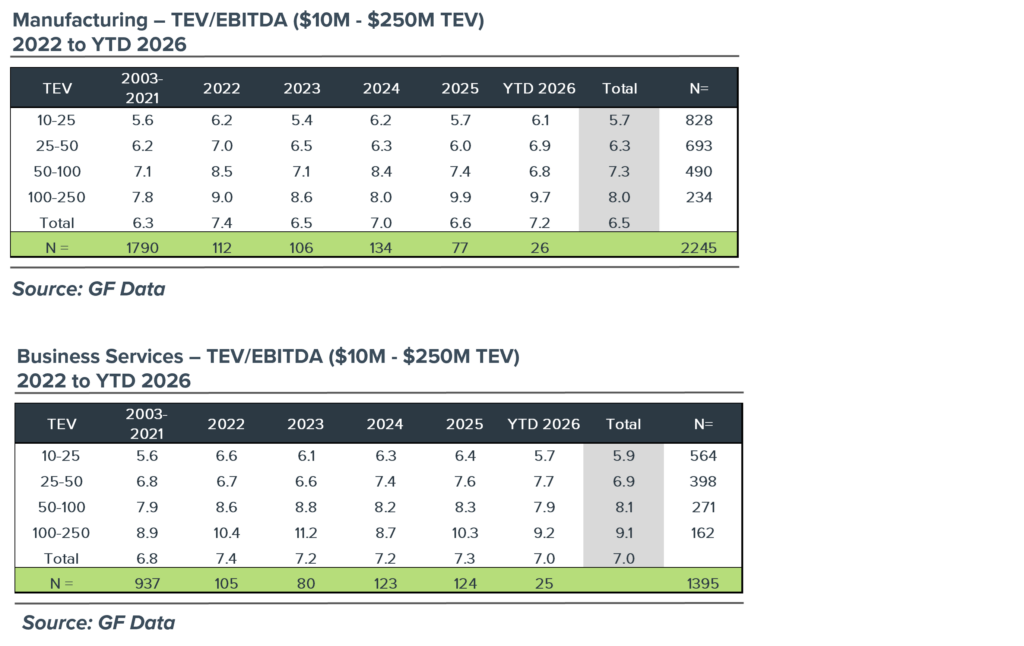
Manufacturing led the major GF Data industry categories in Q1 2026, with average valuation increasing to 7.2x EBITDA from 6.6x for full-year 2025.
- The sector also posted its highest quarterly deal count in five quarters, a constructive signal that buyer confidence is returning despite continued sensitivity to input costs.
- Business Services experienced its first notable softening in roughly three years, reflecting weaker add-on pricing and a more demanding review of AI-related business-model risk.
- The distinction matters: demand remains strong for scaled, platform-grade business services companies with differentiated capabilities and durable customer relationships.
- Strategic buyers and private equity sponsors remain highly selective, concentrating attention on sectors with durable demand, recurring revenue and clear opportunities for operational improvement.
Leverage & Capital Structure
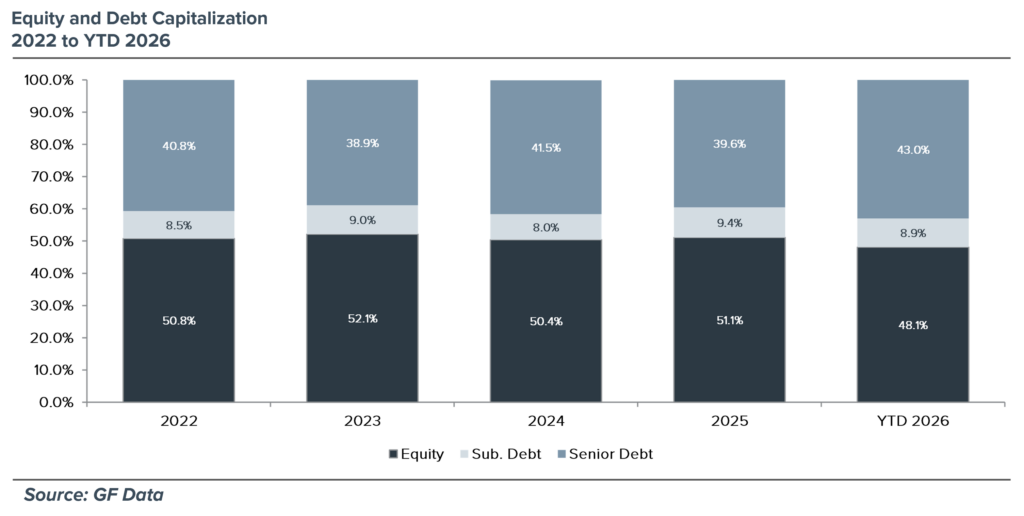
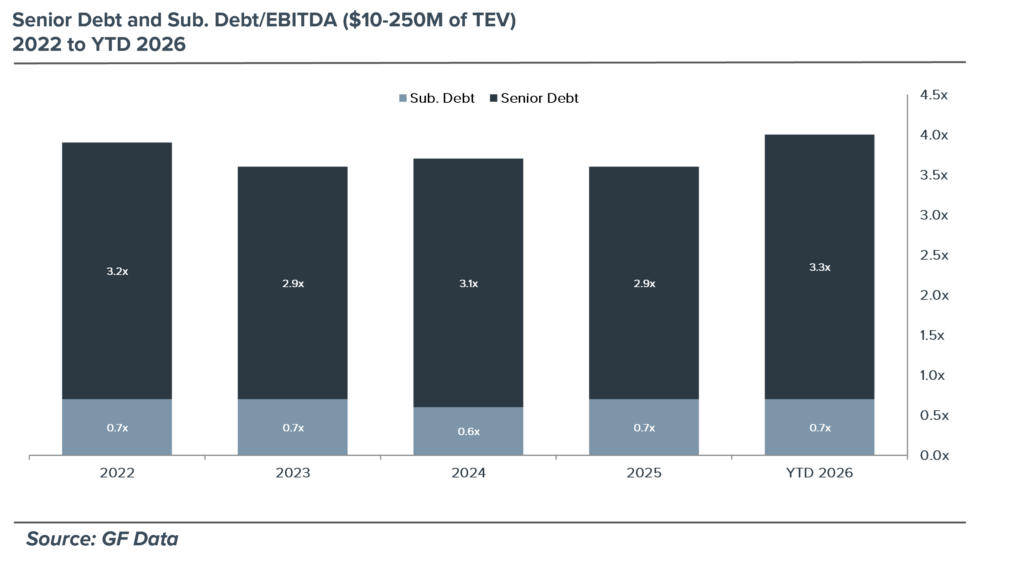
Debt capacity improved in early 2026, with average senior debt rising to approximately 3.3x EBITDA and subordinated debt holding near 0.7x, bringing total debt to roughly 4.0x.
- The capital mix shifted accordingly: senior debt increased to approximately 43.0% of capitalization, while equity declined to roughly 48.1% from 51.1% in 2025.
- Subordinated debt remained relatively stable at approximately 8.9% of capitalization, continuing to fill gaps where senior leverage alone is insufficient.
- The benefit is not universal. Quality credits are receiving better leverage and terms, while smaller or structurally challenged borrowers still require more equity and tighter protections.
- Financing is available, but lenders are allocating it selectively and increasingly expect a credible downside case before stretching on leverage.
Macro & Geopolitical Backdrop
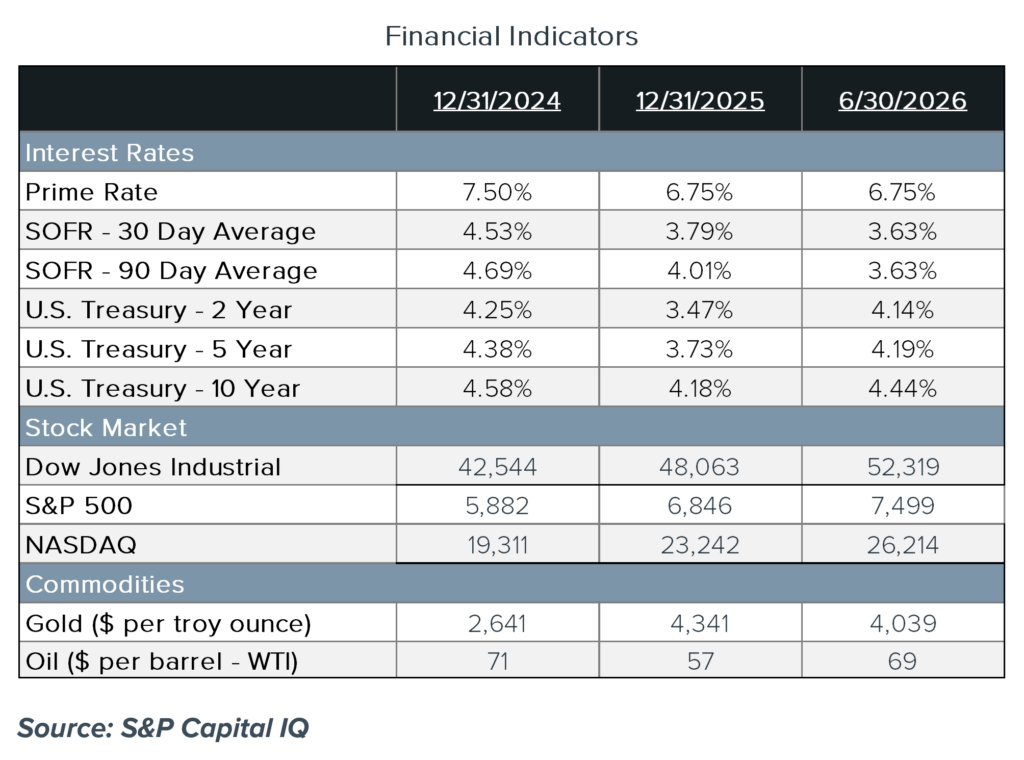
The Iran conflict and resulting oil-price spike quickly became the defining macro shock of early 2026, reviving concerns around energy-driven inflation and operating costs.
- Rate expectations moved just as quickly, from multiple cuts in 2026 to an extended hold, with hikes back in the discussion if energy inflation proves persistent.
- Greater tariff stability is a meaningful improvement from 2025, but companies are not treating supply-chain resilience or pricing power as solved issues.
- The macro backdrop is not stopping transactions. It is changing the questions buyers ask, especially around margins, demand visibility, working capital and downside protection.
- The macro backdrop is not preventing transactions; it is increasing diligence on margins, demand visibility, working capital and downside protection.
Artificial Intelligence and M&A
AI is accelerating strategic investment while putting selected software and technology-enabled service models under a brighter, and less forgiving, spotlight.
- Credit investors are reassessing software durability, producing wider spreads and greater price dispersion for businesses viewed as exposed to disruption.
- At the same time, AI infrastructure, data centers, industrial automation and select healthcare technology remain highly attractive investment themes.
- Diligence is moving beyond generic AI claims. Buyers want evidence of proprietary data, defensible workflows, meaningful switching costs and a credible technology roadmap.
- Companies unable to demonstrate how they will adapt their products, processes and business models may face greater valuation pressure and execution risk.
Implications for Business Owners
- Companies considering a sale should not wait for a perfect macro window, it rarely arrives. Current conditions reward businesses that can prove earnings durability through volatility.
- Build the evidence early: at least 24 to 36 months of clean monthly financial information, customer-level analytics and a defensible bridge from reported to adjusted EBITDA.
- Address AI exposure directly and credibly. Buyers will distinguish between companies using AI to improve productivity and those facing genuine structural displacement risk.
- Demonstrate pricing power, supply-chain resilience and the ability to protect margins when energy and input costs move against you.
- Establish financing credibility before the process begins. Quality-of-earnings work, working-capital analysis and lender-ready projections can materially reduce execution risk.
- Expect dispersion to persist. Strong assets can still command premium outcomes: average businesses may need more time, more flexibility or more structure.
Prairie Outlook: Summer 2026
- The middle-market recovery remains intact, but Q1 data confirms that it is gradual, selective and unwilling to reward every company equally.
- Deal activity below $500 million softened from Q4, while private equity exit value surged on fewer transactions, an unmistakable sign that larger deals are carrying the headline numbers.
- Valuation and leverage improved in selected areas: the $25 million to $50 million valuation tier strengthened, senior debt reached approximately 3.3x EBITDA and equity contributions declined.
- Buyer demand remains strongest for companies with scale, recurring revenue, differentiated capabilities and an organic growth plan that survives diligence.
- The second half of 2026 can still produce a stronger transaction environment, but leveraged loan issuance and deal counts suggest that a broad-based reopening has not yet arrived.
“The market is not waiting for perfect certainty. It is rewarding companies that are prepared before confidence returns more broadly.“
Tim Witt is a Managing Director and can be contacted at 630.413.5593 or by email, tim.witt@prairiecap.com; Anthony Dolan is a Managing Director and can be contacted at 630.413.5593 or by email, adolan@prairiecap.com.
Download the PDF above.


