
For companies that have grown through acquisitions, goodwill and intangible assets can represent a significant portion of the balance sheet. While these assets are recorded at the time of a transaction, their value is not static. Changes in economic conditions, industry dynamics or company performance may require management to evaluate whether the value recorded on the balance sheet remains supportable. That evaluation takes place through impairment testing.
ASC 350 and ASC 360 provide the accounting framework for assessing potential impairments. Although the requirements vary by asset type, both standards aim to ensure that financial statements accurately reflect current business conditions. Understanding when testing is required, who is involved in the process and how to prepare can help companies avoid surprises during financial reporting and audit procedures. While an impairment charge does not necessarily affect day-to-day operations or cash flow, it may draw additional attention from lenders, investors, boards of directors and auditors. As a result, management teams are often well-served by monitoring potential triggering events throughout the year rather than waiting until impairment testing is required.
How Do ASC 350 and ASC 360 Differ?
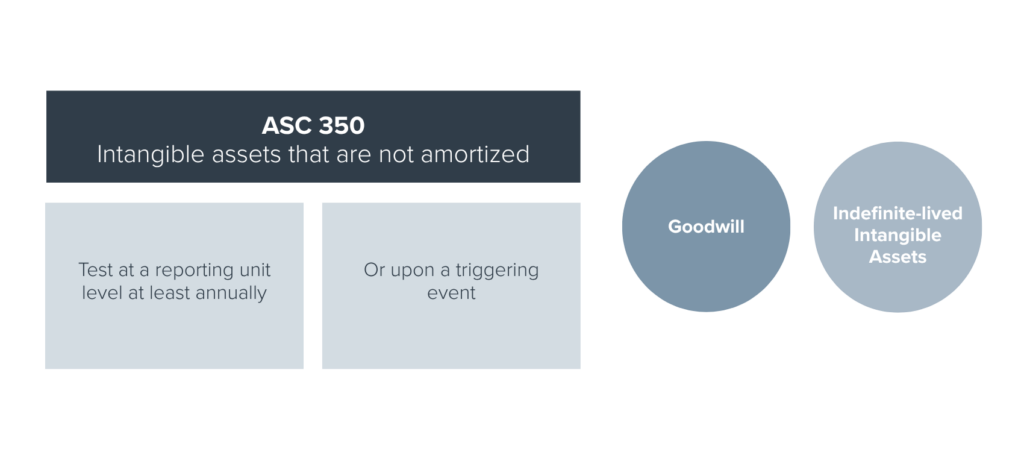
Figure 1
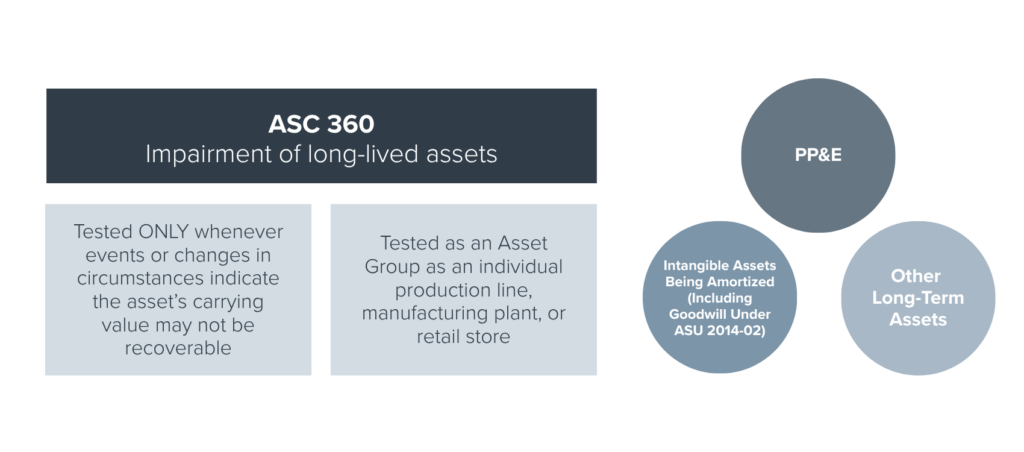
Figure 2
Figures 1 and 2 provide a high-level overview of the assets covered by ASC 350 and ASC 360 and the circumstances under which impairment testing may be required.
ASC 350 primarily addresses goodwill and certain indefinite-lived intangible assets. Goodwill is commonly created during an acquisition and represents value that is not separately identified, such as an assembled workforce, brand reputation, expected growth opportunities and other economic benefits acquired as part of a transaction.
ASC 360 applies to long-lived assets used in the operation of a business, including property, plant and equipment (“PP&E”) as well as certain amortizing intangible assets.
While the two standards are often discussed together, they apply to different asset categories and follow different impairment testing requirements. Companies that have completed acquisitions may be subject to one or both standards, depending on the assets recorded in the purchase accounting process.
When Is Impairment Testing Required?
The timing requirements under ASC 350 and ASC 360 differ significantly.
Under ASC 350, goodwill and certain indefinite-lived intangible assets are generally evaluated for impairment at least annually. In addition, testing may be required between annual reviews if events or circumstances suggest that the recorded value of those assets may no longer be supportable.
Private companies may elect the accounting alternative provided under ASU 2014-02, Intangibles—Goodwill and Other (Topic 350): Accounting for Goodwill. This election allows goodwill to be amortized on a straight-line basis over a period of up to 10 years and eliminates the annual impairment testing requirement. Instead, goodwill is tested for impairment only when a triggering event occurs, indicating that the fair value of the entity or reporting unit may be below its carrying amount.
Impairment testing is typically performed at the reporting unit level. In practice, a reporting unit is often a division, subsidiary or business segment that management evaluates separately.
ASC 360 follows a different approach. Long-lived assets are not subject to annual impairment testing. Instead, testing is required only when events or changes in circumstances indicate that the carrying value of an asset may not be recoverable.
Under ASC 360, companies generally look at groups of related assets together when determining whether impairment exists.
Is Impairment Testing Only an Annual Requirement?
Companies often associate impairment testing with an annual reporting requirement. However, significant business developments may necessitate testing between annual review dates.
For example, triggering events may arise when a company loses a key customer, experiences a significant decline in profitability or operates in an industry facing substantial disruption. In those situations, management cannot simply wait until the next scheduled annual testing date. Instead, the company may need to perform an interim assessment based on the facts and circumstances at that time.
While annual impairment testing often receives the most attention, many impairment analyses begin when management identifies a potential triggering event during the year rather than when a scheduled testing date arrives.
How Do Companies Identify Potential Triggering Events?
One of the most important aspects of impairment testing is determining whether a triggering event has occurred. Triggering events can stem from a variety of internal and external factors, including changes in economic conditions, industry trends, operating performance and company-specific circumstances. Figure 3 illustrates several common considerations for ASC 350 triggering events.
For long-lived assets under ASC 360, additional indicators may include significant declines in asset values, adverse legal or regulatory developments, ongoing operating losses or plans to dispose of assets sooner than expected.
Management’s assessment should consider all relevant facts and circumstances, including company-specific developments, industry conditions and broader economic trends. In some cases, multiple factors may contribute to the determination that impairment testing is necessary.
For example, a manufacturer may lose a major customer while simultaneously facing higher material costs and slowing demand in its end markets. While any one of those developments may not independently indicate impairment, together they may warrant a closer review of the company’s goodwill, intangible assets or long-lived assets.
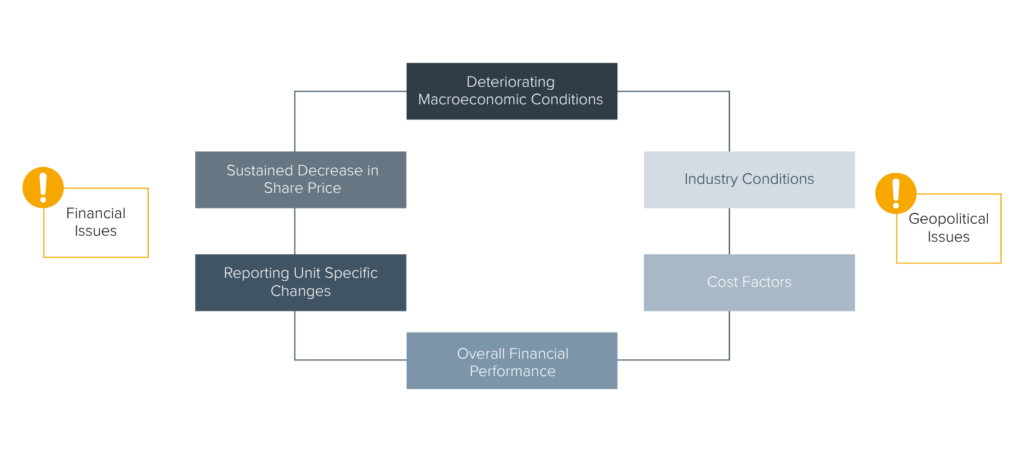
Figure 3
What Happens During an Impairment Analysis?
While the details vary depending on the asset being evaluated, most impairment analyses involve collaboration among management, valuation specialists and auditors. The process typically begins with a review of financial performance, forecasts, industry conditions, market developments and company-specific events to determine whether additional analysis is necessary.
When a triggering event affects multiple asset categories, impairment testing generally must be performed in the following order:
- ASC 350 indefinite-lived intangible assets: Test and record any impairment.
- ASC 360 long-lived assets (including amortizing intangible assets): Test and record any impairment or write-downs.
- ASC 350 goodwill: Test goodwill after any impairment charges from earlier tests have been recorded.
If goodwill testing is required under ASC 350, companies may first perform a qualitative assessment to determine whether it is more likely than not that the fair value of a reporting unit is less than its carrying value. Factors commonly considered include macroeconomic conditions, industry and market developments, changes in costs, financial performance and company-specific events. If the qualitative assessment indicates potential impairment, or if management elects to bypass that step, a quantitative analysis is performed to estimate the fair value of the reporting unit and compare it to its carrying value. If the carrying value exceeds fair value, an impairment charge may be required, limited to the amount of goodwill assigned to the reporting unit.
ASC 360 follows a different process for long-lived assets. The analysis generally involves three steps:
- Identify potential impairment indicators affecting the asset group.
- Assess recoverability by comparing the carrying value of the asset group to the total undiscounted future cash flows expected from its use and eventual disposition.
- Measure impairment, if necessary, as the excess of carrying value over fair value.
Effective impairment testing often requires coordination among management, valuation specialists and auditors. Financial forecasts, strategic plans, industry data, historical financial statements and supporting documentation may all be requested during the process. Because auditors often review the analysis as part of the financial reporting process, early communication among key stakeholders can help avoid delays as reporting deadlines approach.
How Can Companies Prepare for Impairment Testing?
Impairment testing often requires a significant amount of financial, operational and market information to support the analysis. Figure 4 highlights several examples of the materials that may be requested during the process.

Figure 4
Since impairment testing relies heavily on forecasts, historical financial information, market data and valuation-related documentation, the process can take longer than many companies expect. Waiting until year-end to begin gathering information may create unnecessary pressure on management and advisors alike. Beginning the assessment process early can help companies identify potential issues, assemble supporting documentation and address questions before reporting deadlines become a concern.
Key Takeaways
ASC 350 and ASC 360 address different categories of assets and follow different impairment testing requirements. Companies that have completed acquisitions may be subject to one or both standards, depending on the assets recorded in the purchase accounting process.
While some impairment testing is performed as part of an annual review process, changes in business conditions may require companies to evaluate potential impairments between scheduled testing dates. Changes in company performance, market conditions, customer relationships or industry dynamics can all create circumstances that warrant additional analysis.
Because impairment testing often relies on forecasts, market data and supporting documentation, preparation is an important part of the process. Identifying potential triggering events early and gathering the necessary information in advance can help companies navigate impairment assessments more efficiently and support well-informed financial reporting decisions.
Rebecca McElwain is a Director at Prairie Capital Advisors, Inc. She can be contacted at 614.768.7302 or by email, rmcelwain@prairiecap.com.
Download the full article above.


