
An employee stock ownership plan (“ESOP”) gives employees a financial stake in a company, but a stake alone does not guarantee that employees understand what drives the value of their ownership. Employees still need to know how the business makes money and why their work matters to the company’s long-term success. That is where communication becomes central to building an ownership culture. Many companies assume that ownership culture happens automatically once shares are allocated. However, simply allocating stock will not translate into what we think of as internal value creation. That happens when ownership is paired with effective communication and education that teaches employees how the company makes money and how their role fits into that picture.
What Employees Actually Want to Understand
Practical, plain-spoken communication, not technical vocabulary, is the best way to turn employee ownership from an abstract benefit into something employees can understand and connect to their everyday work. Building that kind of understanding starts with recognizing that no two workforces are the same. An architecture, engineering or construction firm has different needs than a manufacturer running three shifts. Moreover, companies with a large number of employees whose first language is not English face an added communication challenge. When it comes to communication, tailoring the message directly to a company’s workforce is critical and it needs to feel like it is coming from leadership and people employees already trust. That emphasis on delivery over technicality runs deeper than tone alone. The financial and accounting mechanics behind an ESOP make up only about 5.0% of the equation, while the remaining 95.0% centers on communication: how effectively and consistently a company delivers its message and how well it connects to the issues that matter most to employees.
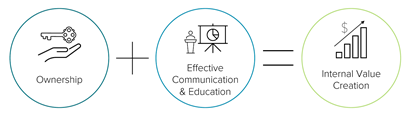
Figure 1: Internal Value Creation
Companies with employees spread across multiple locations face a real challenge in keeping that communication consistent. Single-location companies have the ability to gather everyone once a month or once a quarter in the same room. Companies spread across a wider geography or with rotating shifts tend to rely on different tools instead, such as a recorded management message or a webinar scheduled around different work times.
Making the Financial Story Make Sense
Personal finance comparisons give leadership a ready-made way to explain financial concepts that employees might otherwise struggle to understand. Rather than walking employees through a balance sheet line by line, leadership can point to familiar concepts, such as home mortgages, to explain financial terms. Paying down debt increases equity in the business the same way it builds equity in a house. Growing the business is another way to do the same. Figure 2 shows how these two paths can lead to the same broader outcome: a higher equity value. Framing debt paydown and growth side by side helps employees see that they are not competing priorities, but different ways of building value. Checking accounts, savings accounts and paying down credit card or student loan debt work the same way, and leadership can lean on whichever comparison best matches what a given group of employees already manages in their own lives.
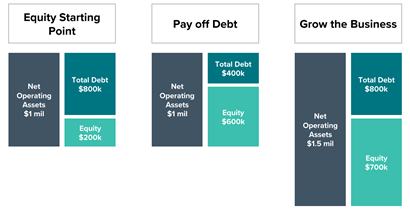
Figure 2: How Does Equity Value Grow?
Earnings before interest, taxes, depreciation and amortization (“EBITDA”) is another term worth translating rather than assuming employees will absorb with little context. While EBITDA is calculated as net income plus taxes, interest expense, depreciation and amortization, leadership can explain it more simply as a way to answer one practical question: “How much debt-free cash flow is our company generating?”
A lemonade stand example gives leadership another way to build financial literacy from the ground up rather than starting with jargon. Starting with a simple, relatable business in dollar-and-cents terms, and later connecting that same lemonade stand to concepts like capital allocation or expanding into new markets, lets employees connect what they already understand to the business they work for. This analogy can be used consistently, whether explaining to individual employees how shares are allocated or preparing a formal presentation for a trustee. For example, leadership might explain that if a lemonade stand earns $25, the owner has a choice: keep the cash, pay back money that was borrowed to start the stand or reinvest in another cooler so the stand can serve more customers next weekend. Later, the same example can show what happens when the stand considers opening on another block, where growth may create opportunity but also require more supplies and labor.
For companies concerned about sharing sensitive figures, actual-versus-budget scorecards, like the one shown below (Figure 3), give leadership a way to communicate performance without revealing exact numbers that could be sensitive if shared outside the company.
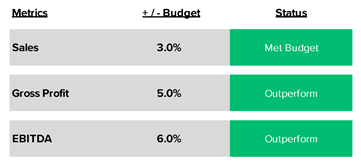
Figure 3: Actual vs. Budget Performance
The Ownership Culture Pyramid
Ownership culture tends to build in stages, often shown as a four-level pyramid (Figure 4). At the first two levels, employees move from simply knowing the company has an ESOP to understanding it as a long-term plan rather than a quick payout. At the third level, that understanding starts to shape daily decision-making. For example, at one large East Coast manufacturer, managers who see new employees misusing forklifts do not just correct the behavior. They explain why it matters, walking employees through how damaging a company asset can affect the stock price and, in turn, their own accounts. The point is not only to stop one behavior, but to help employees connect everyday actions to enterprise value. The fourth and highest level moves from understanding value to taking responsibility for it. In some companies, that may mean assigning an employee to track and report on a specific high-cost line item. In that case, managing cost is no longer an abstract company priority. It becomes part of an employee’s own area of accountability.
Figure 4: The Ownership Culture Pyramid
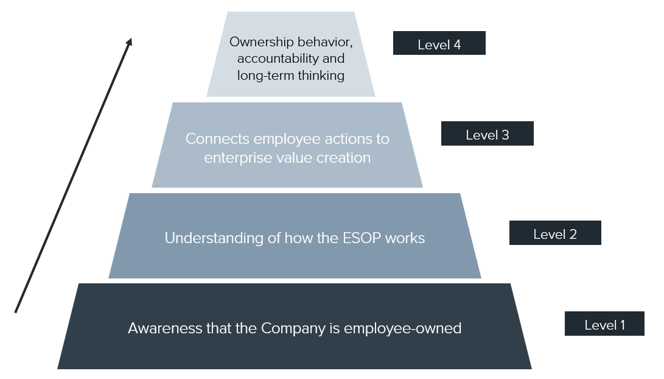
Reaching that top level does not happen overnight. Building a genuine ownership culture takes sustained, intentional communication over time, not a single meeting, annual statement or Employee Ownership Month event. Because employees can easily look for answers on their own, leadership should communicate clearly and consistently before rumors or incomplete information fill the gaps.
Executive Presence Matters
Presence is a real part of leadership’s role: being seen, communicating often, speaking employees’ language and staying consistent, even in harder moments. For a company with 50 employees, walking among the team regularly is fairly straightforward. For organizations with thousands of employees spread across locations, leadership teams often divide and conquer, coordinating so that everyone hears a consistent message with the same level of importance. One manufacturer found that when executives who normally dressed formally switched to more casual attire during site visits, employees who had not previously recognized them by sight became noticeably more comfortable approaching them with questions. That kind of engagement, built over roughly two years of frequent, consistent visits, marked a real shift in how connected the workforce felt to leadership.
Building Structure Around the Message
A few concrete practices help keep this kind of communication consistent. At Prairie, regular project manager meetings provide a small-group setting to discuss best practices, areas for improvement and issues affecting the business. The value of that format is not limited to the specific meeting structure. It shows how smaller forums can make candid, practical conversations easier than they might be in front of the whole company. That same need for structure is where an ESOP or communication committee can help. A dedicated committee gives the effort a strategic mission and designates a group responsible for developing shared information, promoting the ESOP culture and coordinating events like an annual Employee Ownership Month celebration. Setting up a dedicated email address, sometimes anonymous, for ESOP questions gives employees a low-pressure way to ask what they do not understand. Video communication, even simple and unpolished, has become increasingly common as a way to reach employees directly, and some companies have found ways to repurpose that same content for recruiting on platforms like Instagram or TikTok.
Celebrating milestones is also worth the investment. Whether it is a revenue target, a reduction in waste or a company anniversary, these moments reinforce that goal-setting and contribution create value and align the company’s success with the ESOP’s. New employee introductions and sharing hobbies and personal details help build a sense of team that goes beyond spreadsheets and backlog.
A Quick Self-Check for ESOP Companies
Companies that build the strongest ownership cultures consistently and repeatedly connect what employees do each day to the value they help create. For any leadership team looking to evaluate where their own company stands, a few questions are worth asking on a regular basis:
- Frequency: Is communication happening more than once a year, beyond the annual statement?
- Clarity: Are financial concepts translated into terms employees can relate to, rather than technical language?
- Consistency: Is leadership visible and consistent, especially when news is difficult?
- Structure: Is there a dedicated committee or process responsible for driving this communication forward?
- Recognition: Are milestones and achievements actually being celebrated, or left to go unnoticed?
Companies that can answer “yes” to most of these questions are usually the ones furthest along in building a true ownership culture, where ownership has stopped being a line on a statement and become part of how people actually work. While the process is gradual, the companies that invest in it are often the ones that turn ownership on paper into ownership in practice.
Christopher Silvetti is a Director at Prairie Capital Advisors, Inc. He can be reached at csilvetti@prairiecap.com or 312.445.9209.
Download the full article above.
Related Resources
View Allwebinar


